NAVIGATION
GCE A Levels

The Cambridge International A Levels open up a world of educational opportunity for highly motivated for post-SLC (or equivalent-level examinations) students. This gold standard of CIE, a department of the university of Cambridge and a world leader in assessment and curriculum  development-is an excellent preparation for a university education anywhere. Every year, thousands of Cambridge International A level students gain places at good universities in the UK, USA, Canada, New Zealand, and Australia. Perhaps, it is for this reason that entries in CIE examination sessions have been growing yearly-worldwide entries rose by 14% in teh June 2009 examination session on the previous year for instance! An internationally recognized qualification at secondary level, the General Certificate of Education (GCE) is available in over 125 countries.

Course requirements divide the subject content of the A-Level syllabuses into two parts: the AS syllabus content, which is expected to be covered in the first half of the course, and the second part of the syllabus, commonly referred to as A@, taken at the end. However, there are certain subjects that are only available at AS level and can be taken as free-standing qualifications.

International AS and A Level examination sessions occur twice a year, in June and November, with results issued in August and January respectively. AS and A Levels use a wide range of assessment processes and techniques to supplement formal written examinations -practicals, projects and coursework. In order to be awarded an A Level, the student need to complete stipulated conditions enshrined in the Course Structure.

A student's achievement is reported on a grade scale from A (embracing the superlative A*), awarded for the highest level of achievement, to E, indicating the minimum required performance.

Our information about Cambridge International A Levels bears reference to the CIE website www.cie.org.uk


A Levels at TRINITY


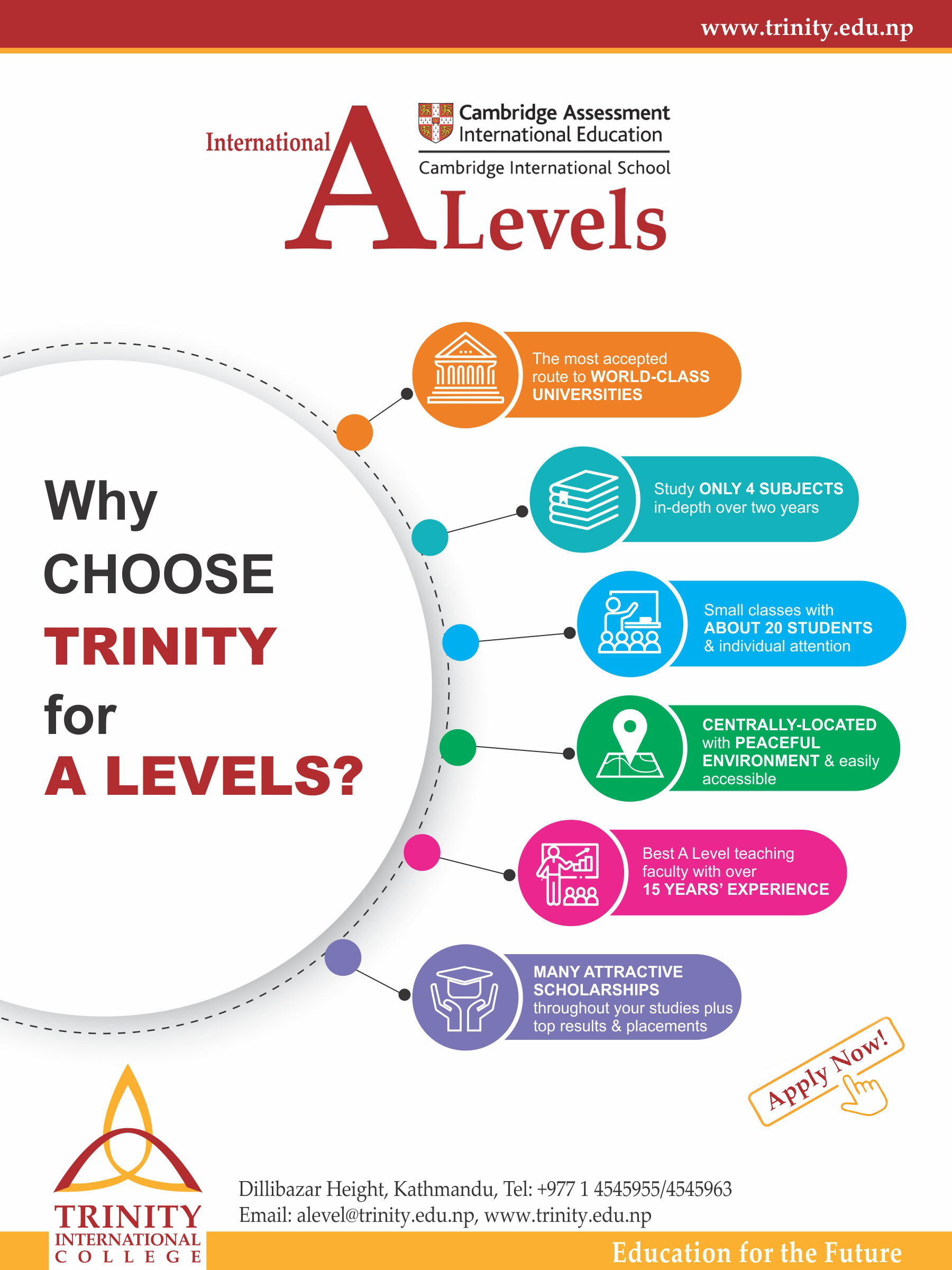
Trinity International College envisages delivering the best available A level instruction and all-round educational opportunities to students admitted to our special Cambridge International A Levels course - a fine study option - enabling them to realize their potential and skills. We concentrate upon academics and personality development in order to fulfill the present and future needs of our splendid pupils, especially their enhanced success in university studies abroad.


Trinity offers a combination of reasonably wide and decidedly pragmatic choice of subjects for AS and A Levels. This combinational flexibility covers science and non-science subject areas. Students have the freedom to select the subjects that are right for them - our Academic Counselors guide the newly enrolled entrants to choose subjects and study pathways. These secondary school students can either follow a broad course of study or specialize in a particular area of knowledge. Students have to choose at least three subjects at A Level in addition to the General Paper (English) - the compulsory core subject - AS Level.


Satisfactory A Level grades can also be a key to university admissions which accommodate Credit Transfer and Advanced Standing (Particularly in the USA or Canada) and give A-Level students access to undergraduate studies at the very best institutions of higher learning: Oxford, Cambridge, and the world's major universities such as Harvard, Yale, Heidelberg, and Sorbonne.


Examinations in Nepal are managed by the British Council Kathmandu, which is the recognized centre for GCE exams for Trinity International College.


Fee Structure


S No Particulars Science Non-Science
AS A-2 AS A-2
1 Admission Fee 15,000   15,000  
2 Security Deposit 9,000   9,000  
3 Annual Fees 24,000 24,000 24,000 24,000
4 Tuition Fee 96,000 96,000 96,000 96,000
Total   144,000 120,000 144,000 120,000
Annual Laboratory Fee per subject 7,000 7,000

Note:

  1. Admission Fee is applicable for the first year only at the time of admission.
  2. Security Deposit is refundable only after the successful completion of the program.
  3. Annual Fees include the expenses related to library, ECAs, ICT access, hand-outs,  internal assessments, Kathmandu Valley-based field works, seminars, workshops, program orientation, and other similar events.
  4. Tuition Fee is applicable for 24 months @ Rs. 8,000 for Science and Rs. 8,000 for Non-Science stream per month.
  5. The  University of Cambridge and MOE, Nepal, Registration as well as subject-wise Examination Fee (CIE) are not included in this package given above.


Sessions & Examinations


The two-year academic sessions of GCE A Levels operate from July to June. 

The examinations are conducted biannually, viz. May/June and October/November. The results are published in August and February respectively.
 
The individual subjects are graded alphabetically. A is the highest whereas E is the lowest level of achievement. Papers that do not meet the minimum stipulated requirements remain ungraded (U).


Admission


The admission at TRINITY International (A Level) College is based on a fair,

competitive selection process culminating in the TRINITY Entrance Test.


Scholarship


The College offers a wide range of Scholarships to deserving students who fulfill the expected criteria under the A Level Scholarship Programme 2010.
 
 
Type
Particulars
Science
Non-Science
 I
National Merit Scholarship
Full scholarships for outstanding students

3 seat

Min.90% in SLC

2 seats

Min. 88% in SLC

 II
Distinctive Achievement Award
50% tuition fee waiver

3 seats

Min. 90% in SLC

2 seats

Min. 85% in SLC

 III
Entrance Topper Scholarship
100% tuition fee waiver
1 seat

1 seat

 IV
District Topper Scholarship
50% tuition fee waiver
Min. 85% in SLC on DEO's certification
V
Sponsored Scholarship

Subject to availability of sponsors and given funds

 
VII
Trinity Scholar's Award

Full or partial tuition fee waiver based on performance in Terminal Exams

3 seats

2 seats


Subject Combination


Trinity offers the following specially designed A Level subject combinations to fulfill the requirements of and to prepare students for university studies such as science, medical, engineering, business, and liberal arts.
Science
 
Non-Science
Group S-1
   Group S-2              
Group NS-1         
  Group NS-2                    
General Paper
Physics
Chemistry
Biology
 
Additional
Mathematics
Computing
 
General Paper
Physics
Chemistry
Mathematics
 
Additional
Mathematics - Further
Computing
 
General Paper
Accounting
Economics
Business Studies
and / or
Mathematics
 
Additional
Computing
Art and Design
 
General Paper
Economics
Sociology
Psychology
 
Additional
Art and Design
Environmental Management
Language & Literature
in English
Mathematics
 

 * Students from particular groups can take additional subjects from any of the other given groups only after permission.

* CIE recommends that students take no more than 5 subject areas.